

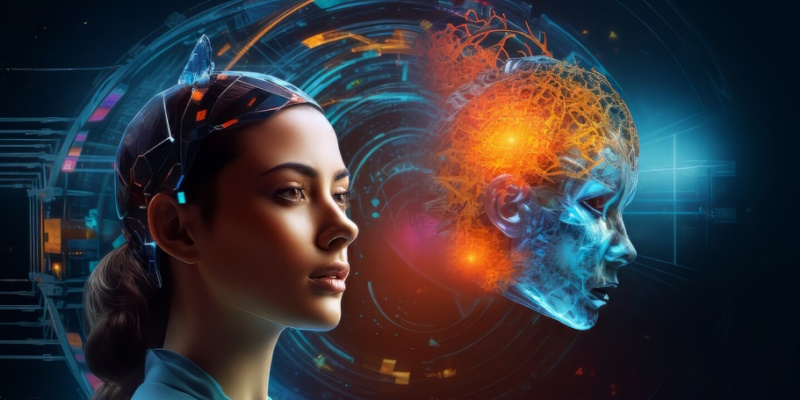
The screen blinks. The cursor pulses. You have an idea, but you don’t write it. You type a prompt. Within seconds, a fully formed paragraph, a block of code, or a complex strategy document appears. You edit it slightly, hit send, and feel a surge of productivity.
But there is a quiet, gnawing feeling in the back of your mind. It is the suspicion that while your output is accelerating, your internal engine is slowing down.
You are building tools to conquer the world, yet you might be outsourcing the very thing that makes you capable of leading it: your ability to think deeply, critically, and originally.
This isn’t about Luddism or fear-mongering. It is about the uncomfortable reality of Cognitive Singularization of the Self.
It is the phenomenon where, by teaching machines to think for us, we inadvertently teach ourselves how to stop thinking.
If you are an entrepreneur, a creator, or a knowledge worker, this is the most critical threat, and opportunity, of your career.
The Neural Efficiency Trap
To understand why this is happening, you have to look at how the brain actually works. The human brain is a masterpiece of efficiency, but that efficiency is a double-edged sword.
Evolution wired us to save energy. Every calorie your brain burns is a calorie not spent on basic survival. Consequently, your brain operates on a “use it or lose it” policy known as synaptic pruning.
If a neural pathway, like the one required to synthesize complex information, map out a logical argument, or debug code line-by-line, is not used regularly, the brain starts to dismantle those connections.
It is essentially saying, “Oh, we aren’t using this road anymore? Let’s close it down to save on maintenance.”
When you rely on AI to handle your cognitive load, you are signaling to your brain that these pathways are obsolete.
You aren’t just using a tool. You are participating in a biological feedback loop that favors convenience over cognitive development.
The more you “prompt” your way through problems, the more you atrophy the deep-thinking muscles that once separated you from the herd.
The “Will to Prompt” vs. The “Will to Create”
There is a distinct difference between commanding a machine and creating a solution.When you struggle with a problem, you are experiencing the cognitive friction that leads to mastery.
It is the mental equivalent of lifting weights. The tension, the frustration, and the ambiguity of the blank page are the resistance that builds neural strength.
But AI removes the friction. It provides the shortcut. The shift happening in the modern workforce is a transition from a “will to create” to a “will to prompt.”
We are becoming curators of machine-generated possibilities rather than architects of original thought. Why does this matter?
If you lose your ability to synthesize, analyze, and innovate without assistance, you become commoditized. You become indistinguishable from the machine you are using.
The market doesn’t pay a premium for people who know how to ask an AI a question; the market pays for the person who knows what to ask and why it matters.
The Erosion of Intellectual Autonomy
Consider the last time you had a truly difficult decision to make. Did you sit with it, weigh the variables, trace the second and third-order consequences.
And then allow the answer emerge from your own synthesis of experience and intuition? Or did you plug the variables into an LLM and see what it suggested?
When you outsource your judgment, you are engaging in Cognitive Singularization. You are slowly merging your decision-making processes with the logic of a probabilistic model.
AI models are trained on the average of human data. They are designed to predict the most likely next word, not the most insightful, courageous, or contrarian idea.
By relying on them for your high-level decisions, you are effectively nudging your own worldview toward the mean. You are regressing toward the average.
Why You Feel Like an Imposter
Many high-performers currently report a strange, low-level anxiety. They feel like imposters, even when their metrics are up and their output is higher than ever.
This is not just a psychological quirk. It is a biological protest. Your brain knows the difference between earning an insight and retrieving it from a black box.
There is a deep, primal satisfaction in “cracking” a problem. It releases neurochemicals associated with agency and competence.
When you skip the struggle, you skip the reward. You are left with the result, but you don’t feel the ownership. You didn’t build the intellectual bridge; you just crossed it.
This lack of ownership creates a hollow success. It makes you feel like you are masquerading as a leader because the “thinking” (the hard work) was done by the model, not by you.
The Choice is Yours
The tools at your disposal are unprecedented in human history. You can accomplish more in a day than your predecessors could in a month. But do not confuse productivity with competence.
You are at a fork in the road. One path leads to a future where you become a mere “operator,” a human interface for a digital mind.
The other path leads to a future where you are a force multiplier, a master thinker who commands technology to expand human potential, rather than diminish it.
Don’t let the convenience of the algorithm make you soft. The machine can generate the text, but only you can provide the intent. It can provide the data, but only you can provide the vision.
It’s time to stop prompting and start thinking.Your next move? Choose one complex project on your desk right now.
Close your browser, grab a physical notepad, and spend thirty minutes mapping out the strategy from scratch, without help, without tools, and without the screen.
Rediscover what you are capable of when the power is truly in your own hands.