

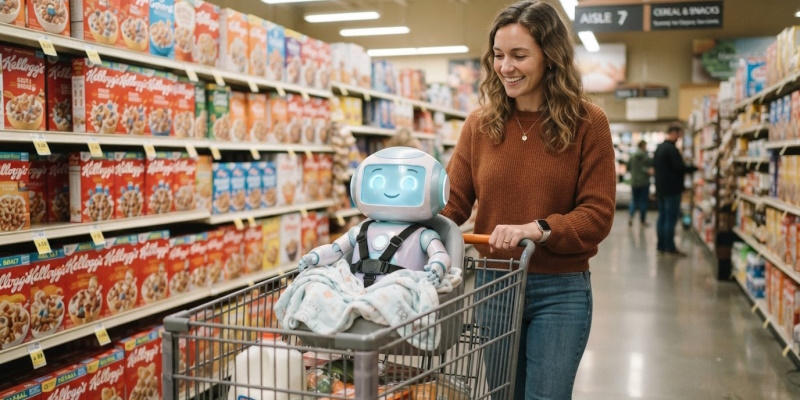
I have never wanted to spend my Tuesday evening clipping digital coupons just to save four dollars on dish soap, yogurt, and laundry detergent. I do want to spend less on the things I buy every week, but I want my life to still feel like mine. That is why AI fits into my shopping routine.
It does not run my life. It gives me a calmer second opinion before I open my wallet. The version of this that works for me is straightforward.
I use AI to compare brands, decide whether bulk deals are actually worth it, build cheaper grocery lists, and catch convenience spending that tends to sneak up over a month.
If you have been wondering how to use AI to save money on everyday purchases without turning into a full-time deal hunter, this is the approach I landed on after a lot of trial and error.
🛒 What It Means to Use AI to Save Money on Everyday Purchases
When people hear “AI shopping,” they sometimes picture an automated deal machine that hunts discounts 24/7. That is not what I do with it. For me, AI is a decision-support tool.
It does not replace price apps, cashback tools, or store promotions. It just gives me a clearer head before I spend.
Most everyday overspending does not come from one big mistake. It comes from a pile of small, tired decisions that feel harmless in the moment. AI is useful precisely because it slows those down.
The simplest definition
In practical terms, I use AI to do four things: compare similar products faster, simplify pricing logic, suggest lower-cost alternatives, and help me organize decisions around actual value rather than impulse. That is the whole point. Less friction when I am tired and standing in an aisle.
Where AI saves me the most
The biggest wins show up in categories where I buy on repeat and where branding has more influence than actual need.
For me, that means groceries, cleaning products, paper goods, over-the-counter pharmacy basics, skincare staples, pantry items, pet supplies, and the convenience charges from delivery apps. None of these are exciting. All of them add up.
When AI helps and when it does not
AI is best when the decision is fuzzy. If I am stuck choosing between a store brand and a name brand, comparing two package sizes, or wondering whether my grocery list has unnecessary extras, AI helps a lot.
If I need a live price on a shelf or a flash deal that ends in an hour, I still verify that separately. AI is good at reasoning and comparison. It is not a live inventory system.
🧠 The Exact Way I Use AI Before I Buy Anything
My rule is simple. If I am hesitating, comparing, justifying, or rationalizing, that is when AI gets useful. I do not open it for every banana or bottle of hand soap.
I open it when a purchase has enough ambiguity, that I know my tired brain could talk me into spending more than I should.
I ask AI to compare value, not just price
A lower price does not always mean a better buy. Sometimes the cheaper option comes in a smaller size, lasts half as long, or leaves me replacing it faster. Sometimes the premium product really is just paying for nicer packaging.
So instead of asking, “Which one is cheaper?” I ask something like, “Compare these two by cost per use, likely quality difference, and whether the higher price is justified for an average household.” That one change in phrasing tends to produce a much better answer.
I use AI to translate unit pricing into plain English
Unit pricing is useful, but it is annoying when I am tired. If I am comparing a 24-ounce cleaner with a 32-ounce refill, or a bulk paper towel pack with a smaller one, I will paste the numbers into AI and ask which one is actually more economical in real life.
That matters because some “deals” only look good when you ignore storage, waste, and expiration.
I ask whether a deal is worth it
This is probably where I have saved the most. Retailers are great at making a purchase feel urgent or smart. Buy more, save more sounds rational. Limited-time bundle sounds efficient. Free shipping if I add twelve dollars sounds harmless.
AI helps me pause and ask, would I still buy this if it were not framed as a deal? That single check has stopped a lot of impulse spending.
🏠 My AI Routine for Groceries, Household Items, and Personal Care
Most of my savings come from ordinary weekly decisions, not from dramatic money hacks. That is why I built a simple AI shopping routine around the categories I buy most often.
How I build a cheaper weekly grocery list
I start with the list I actually want, not the list I think I “should” want. Unrealistic frugality does not last. If I build a shopping plan around foods I will not cook, I am just shifting waste to a different stage.
Once I have my normal list, I ask AI to do three things: identify the most expensive items, suggest lower-cost substitutions that still support the same meals, and flag anything that looks optional rather than essential.
How AI keeps meals realistic
If my week includes tacos, pasta, sheet-pan chicken, oatmeal, yogurt bowls, and a couple of easy lunches, I ask AI to suggest the cheapest version of that menu without turning it into a completely different lifestyle.
I do not want every meal replaced with lentils and frozen spinach if that is not how I actually eat. I want the meals to stay recognizable and doable, just less expensive. That balance is what makes the routine stick.
How I use it to spot substitute products
This is most useful for packaged foods, sauces, snacks, and branded pantry staples. I ask whether the cheaper version is likely close enough in taste or function for everyday use, and where the upgrade probably matters.
AI cannot perfectly predict my taste, but it is good at helping me decide when the difference is meaningful and when it is mostly branding.
How it stops sale-driven overbuying
A lot of grocery overspending does not come from luxury purchases. It comes from adding too much because something is discounted.
If pasta sauce is on sale, I do not need six jars. If berries are discounted, I still should not buy more than I will eat. AI helps me think in realistic household volume instead of store psychology.
🧼 How I Use AI for Household and Cleaning Products
This is one of the easiest categories to optimize, because marketing is doing a lot of the heavy lifting. A cleaner is often just a cleaner. A dish soap is often just a dish soap.
But packaging, scent language, and brand familiarity can make some options feel more “worth it” than they really are.
I compare cost per month, not just cost per bottle
A larger bottle is not automatically a better deal if I use more of it, dislike storing it, or replace it before finishing it.
AI helps me think in terms of cost per month or cost per use instead of cost per container. That makes the decision more grounded.
I check bulk purchases for hidden waste
Bulk buying looks smart on paper, but it can create waste in real households. If something expires, takes up too much space, or encourages me to over consume because I have so much of it, the math changes.
AI helps me evaluate bulk purchases through actual usage patterns instead of idealized savings.
I ask when the premium version is genuinely justified
Sometimes it is. If a product lasts noticeably longer, performs better, or solves a recurring problem, the more expensive option can be the better buy.
What I like about using AI is that it forces the purchase to earn its price instead of letting me justify it on autopilot.
💊 How I Use AI for Pharmacy and Personal Care Purchases
Personal care and pharmacy aisles are where branding gets especially persuasive. That does not mean cheap is always best. It means I want a more rational filter before I spend.
I compare active ingredients instead of packaging
For over-the-counter basics and some personal care items, I ask AI to compare products based on active ingredients, intended use, and practical differences rather than branding language.
That gives me a better starting point for deciding whether the cheaper product is functionally close enough.
I use it to spot convenience markups
Travel sizes, premium wipes, specialty razors, single-use beauty products, and highly branded basics often carry convenience pricing.
AI helps me see those markups more clearly by asking whether there is a lower-cost equivalent that serves the same purpose. Most of the time, there is.
I ask when store brand is likely good enough
This is one of my favorite use cases, because the answer is usually yes but not always.
Instead of automatically grabbing the cheapest option or the one I have always bought, I ask AI to identify categories where store-brand quality is usually acceptable and categories where the difference in performance probably matters more.
🏷️ How I Use AI to Compare Prices Across Stores Faster
Store-to-store comparison is helpful, but it gets tedious quickly. AI does not magically know every live price in every store, but it helps me structure the decision.
I use it to figure out whether it is worth splitting purchases, switching stores, or adjusting when I buy.
Prompts I use to compare retailer value
If I have prices from two or three stores, I ask AI to compare the basket as a whole rather than isolate one item.
That matters because one store may win on produce while another wins on household basics or pharmacy. Looking at the total basket leads to better decisions than chasing a single discount.
How I combine AI with cashback and price trackers
AI becomes most useful as a layer, not a replacement. Cashback apps tell me what is available. Store apps show current prices. Price trackers show trend history.
AI helps me interpret all of that and decide whether a deal is worth acting on now, postponing, or skipping. The apps provide signals. AI helps me think through them.
How I check whether convenience is costing me too much
Delivery fees, last-minute pickup runs, and one-off emergency buys are part of real life. I am not trying to eliminate them entirely. What I do use AI for is spotting patterns.
If I keep paying extra for convenience in the same category, that usually means I need a better default system, not more willpower in the moment.
✨ The Best AI Prompts I Use to Save Money on Everyday Purchases
Good prompts make a real difference. Vague questions get vague answers. The prompts that work best for me are the ones that give enough context to produce a practical recommendation without turning into a novel.
- Groceries prompt. “Here is my grocery list and budget. Suggest lower-cost substitutions that still support similar meals, and flag any items that seem unnecessary for this week.”
- Two-product prompt. “Compare these two by price, size, cost per use, likely quality difference, and whether the more expensive one is worth it for an average household.”
- Real-deal prompt. “This item is on sale in a multi-buy offer. Based on normal household use, storage limits, and likely waste, is buying extra actually a money-saving move?”
- Store-brand prompt. “Is the store-brand version of this product likely good enough for everyday use? Explain where the quality difference may matter and where it probably does not.”
- Impulse-check prompt. “Look at this shopping list and identify which items seem driven by convenience, novelty, or impulse rather than real need. Suggest practical alternatives.”
⚠️ Common Mistakes That Make AI Shopping Advice Less Useful
AI can absolutely help with saving money, but it is not useful if I use it lazily. Most of the mistakes I have made were less about the tool and more about how I framed the decision.
Asking vague questions
If I ask, “How can I save money shopping?” I get broad, forgettable advice. If I ask, “Which three items on this $85 household list are least worth buying this week if I want to cut it to $65 without creating inconvenience later?” the answer gets much more useful. Specificity drives quality.
Trusting AI without checking the final numbers
AI helps me reason through a purchase, but I still verify the final price, pack size, and any product details that matter. That is especially true when I am comparing retailers or acting on a time-sensitive offer.
Using AI after checkout instead of before it
Post-purchase reflection is useful, but prevention is where the real savings come from. AI changes my behavior when I use it during list-building, pre-checkout comparison, and substitution decisions.
💰 Realistic Results: How Much Money AI Can Actually Save
I think this is where people either oversell AI or dismiss it too quickly. AI will not transform a budget overnight, replace income, or erase inflation.
That is not the standard I use. I care whether it helps me make slightly better decisions more consistently.
For me, that has translated into fewer impulse add-ons, fewer premium-brand defaults, fewer fake deals, better grocery substitutions, and smarter handling of repeat purchases.
The savings are usually moderate on any single transaction, but consistent over time. That is the part that matters.
Where I notice the biggest difference
The categories where I consistently notice savings are groceries, household cleaners, paper goods, beauty basics, pantry staples, and convenience-driven online orders. The boring stuff. Which is exactly why it works.
⏱️ My 5-Minute AI Shopping Routine
If I want to keep this simple, I follow a five-minute version.
- I build my normal list.
- I ask AI to identify the easiest cost reductions without making the week less practical.
- I compare a few ambiguous items, especially branded basics and sale items.
- I check whether any “deal” only looks attractive because it is framed well.
- I save the best-performing prompts and reuse them next time.
That is it. I am not spending all day optimizing toothpaste. I am just adding a layer of structured thinking between me and routine overspending.
📋 9 Practical Ways Using AI
I never set out to build a system. I just kept losing the same twelve dollars a week to small overspending habits, last-minute add-ons at checkout, and the occasional “this looks useful” pickup that sat in my pantry untouched for a year.
AI became the layer that turned those scattered habits into something repeatable. This is the actual system I follow each week to save money on everyday purchases without making shopping feel like a side project.
If you are trying to figure out how to use AI to save money on everyday purchases, the version that worked for me was small, weekly, and built around nine specific tactics. None of them are clever. All of them compound.
📝 1) I Let AI Rewrite My Shopping List Before I Leave the House
The fastest way I save money every week is by getting AI to look at my shopping list before I walk into a store.
A rough list is fine as a starting point, but it usually contains a few items I added because I was hungry, tired, or scrolling. AI trims that out in about two minutes.
Here is the exact prompt I use: “Here is my full shopping list and my target budget. Group the items by category, flag any that look optional, and suggest the cheapest realistic substitute for the three most expensive items without changing the meals I planned.”
That single prompt has consistently saved me between $8 and $15 per trip.
How I turn a rough list into a budget-aware list
I write the list first with no filter, the way I would normally shop. Then I copy it into AI and ask for the version that fits my real budget.
That matters because if I ask AI to build a list from scratch, it gives me somebody else’s list. Starting from mine keeps the meals and routines intact.
How AI helps me remove low-priority items
The most useful thing AI does in this step is name which items are likely low-priority. It might say something like, “the fancy crackers, the second type of coffee, and the impulse candle add about $14 and are not connected to any planned meal.”
That phrasing is hard to argue with, and it stops me from rationalizing the extras.
⚖️ 2) I Use AI to Compare Unit Price, Quality, and Convenience Together
A lower price is not automatically a better buy. This is the second tactic in my AI shopping system, and it is the one that catches the most hidden overspending.
I do not just ask, “which is cheaper.” I ask AI to compare products by cost per use, quality difference, and whether convenience is part of the price. That shifts the decision from sticker shock to actual value.
Why cheapest is not always best value
A 24-ounce cleaner at $4 and a 32-ounce refill at $6 look like the refill is the deal. But if the refill bottle leaks, the pump breaks, or I end up using more per load, the math quietly changes. AI helps me see that without me having to test it myself.
The prompt I use for fast side-by-side comparisons
Here is the comparison prompt I keep in my notes: “Compare these two products by price, size, cost per use, likely quality difference, and whether the higher-priced one is justified for an average household. Be specific about where the premium version earns its price.”
That structure produces a much more useful answer than a generic “which is better” question. It also gives me a written explanation I can reread if I am standing in an aisle second-guessing myself.
🔄 3) I Ask AI for Lower-Cost Alternatives That Still Fit My Routine
This is the tactic where I lean on AI as a shopping assistant for household items specifically. Substitution works best when I am honest about what actually matters to me.
If I tell AI the texture, flavor, or function I care about, it usually comes back with one or two realistic alternatives that cost less. If I leave that context out, it gives me generic suggestions I will not actually buy.
Product substitutions that feel realistic
I will often write something like, “I currently buy X Greek yogurt at $1.50 per cup. Suggest two cheaper alternatives that are still thick, not overly sweet, and work in smoothies and overnight oats.”
The answer comes back with realistic options instead of vague advice.
When I keep the premium item anyway
Sometimes the cheaper version is genuinely not worth it, and that is fine. AI helps me see that too. If a product lasts twice as long or performs noticeably better, paying more can be the better decision.
The point is not to downgrade everything. The point is to choose on purpose.
🚨 4) I Use AI to Catch Fake Savings and Marketing Traps
This is where an AI shopping assistant for household items becomes a real money-saver. Retailers are skilled at framing purchases, and I am not immune to it.
Before I commit to a multi-buy offer, a bundled deal, or a “buy one get one,” I paste the offer into AI and ask whether it actually helps a household like mine.
Multi-buy offers that don’t really help
A 3-for-$10 pasta sauce deal only helps me if I will actually use three jars. If I usually buy one a month, two of those jars will sit there long enough to get tossed. AI helps me see that pattern quickly.
“Luxury” packaging on basic products
I have caught myself paying an extra $2 to $4 for the same basic product because the bottle was prettier. Asking AI to compare the products directly usually shows that the difference is purely cosmetic, which makes it easier to put the prettier one back.
Oversized bundles that lead to waste
Bulk bundles get framed as savings, but they often just move waste from one stage to another. AI helps me decide whether I will actually use the volume before I commit, which is the question I would skip if I were shopping on autopilot.
🔗 5) I Pair AI With Price Alerts, Cashback, and Store Apps
This is the layer that makes my whole system work in real conditions. AI is the reasoning. The apps are the live data.
I use a price tracker to confirm whether a sale is real. I use a cashback app to check what is available. Then I bring those numbers to AI and ask whether the deal is worth acting on.
What AI does well vs what apps do better
An AI tool to compare prices across stores does not always have live shelf pricing. That is what the apps are for. But AI is much better at telling me whether a 20 percent discount on a product I rarely use is actually useful to me, which is the part the apps cannot do.
How I stack tools without making shopping a full-time job
My stack is small. One price tracker, one cashback app, one store app for my main grocer, and one AI assistant for comparison prompts. That is it. More tools than that start canceling each other out and turning a five-minute routine into a thirty-minute one.
🍳 6) I Use AI for Meal Planning So I Waste Less Food
Food waste is one of those things that quietly drains a budget without showing up on a receipt. AI has helped me reduce it more than any other tool I have tried.
When I plan meals for the week, I give AI the list of what I already have in my fridge and pantry, plus the meals I want to make. It builds a plan that uses what is already there.
Building meals around what I already have
This is one of the best AI prompts for a cheaper grocery list, because it cuts the starting list before I even get to the store. If I have half a bag of rice, some wilted greens, and chicken in the freezer.
AI helps me build two or three meals around that before suggesting I buy anything new.
Reducing duplicate ingredient purchases
A small but real win. I used to buy parsley, scallions, and limes for three different meals and then throw half of them out. Now I plan meals in a way that shares ingredients across the week. AI flags the overlap instantly so I do not have to catch it myself.
🔍 7) I Ask AI to Review My Repeat Purchases for Hidden Waste
This is where I use AI for reviewing monthly subscription spending and other repeat charges. Repeat purchases are easy to ignore because they feel familiar. AI gives me a fresh look.
Once a month, I paste my last two credit card statements into AI and ask it to flag subscriptions, frequency patterns, and small recurring charges I may have forgotten about.
Which subscriptions deserve a second look
AI usually catches one or two subscriptions I forgot I was paying for, plus a few low-value ones I would not have re-signed up for today. The savings here are not huge, but they are completely passive, which makes them worth the five minutes.
How I spot “default buys” that no longer make sense
The same logic applies to grocery items. If I have been buying the same granola or yogurt for two years, AI helps me ask whether I would still choose it today if I were starting fresh.
Sometimes yes, sometimes no. Either way, the choice is conscious instead of automatic.
📦 8) I Use AI to Prepare for Big Box and Bulk Store Trips
Big box stores like Costco, Sam’s Club, and BJ’s are designed to make bulk feel like a deal. AI helps me decide whether it actually is.
Before I go, I send AI the list, the prices I expect to pay, and how much storage I have at home. It tells me where bulk makes sense and where it just creates clutter.
When bulk saves money
Bulk wins for things I use constantly, store well, and will not let expire. Things like paper towels, certain pantry staples, and cleaning supplies often come out clearly ahead in bulk.
When bulk quietly increases spending
Bulk loses on novelty items, single-flavor snacks, oversized spice containers, and anything with a short shelf life. AI is great at catching these because it can look at the whole list rather than the loudest deal in the cart.
💾 9) I Save My Best Prompts and Reuse Them Every Week
The single most useful thing I did was build a small prompt library. Most of the savings from AI come from running the same few prompts over and over, not from asking new questions every week.
Once I find a prompt that produces a useful answer, I save it. That is how AI prompts for comparing grocery prices and AI prompts to check if a sale is worth it stay consistent in my routine.
My reusable prompt library
I keep prompts for trimming a shopping list, finding cheaper substitutes, checking whether a sale is real, planning meals from what I already have, reviewing monthly subscription charges, and comparing two products side by side.
Six prompts cover roughly 90 percent of my decisions.
How repeated prompts improve speed and consistency
After a few weeks, the routine takes less than five minutes. AI has context for the kinds of meals I cook, the stores I shop at, and the products I usually buy. That makes each answer faster and more accurate than it was the first time I asked.
🌟 The Best AI Prompts From My Weekly Shopping System
A few of the prompts that earn their place in my saved library every week.
- Cheaper grocery list. “Here is my list and budget. Suggest lower-cost substitutions that still support the same meals, and flag any items that seem unnecessary.”
- Two-product compare. “Compare these two by price, size, cost per use, quality difference, and whether the premium version earns its price.”
- Real-deal check. “This item is on sale in a multi-buy offer. Based on normal use, storage, and likely waste, is buying extra actually a money-saving move?”
- Store-brand filter. “Is the store-brand version of this product likely good enough for everyday use? Explain where the difference matters and where it does not.”
- Subscription sweep. “Review this list of monthly charges and flag subscriptions, low-value services, and patterns I should reconsider.”
Together these cover how to use AI to stop impulse buying, how to use AI for weekly meal planning on a budget, and AI for store brand vs name brand comparison in one place.
⚠️ Common Mistakes That Make AI Shopping Advice Less Useful
A few habits to avoid if you want the system to actually work.
Asking vague questions like, “How do I save money on groceries?” produces vague answers. Specificity is what unlocks useful output.
Trusting AI without checking live prices is another trap, since AI does not always know current shelf prices or local deals. Use your apps for that.
And using AI after checkout instead of before it is the most common mistake. Reflection is useful, but prevention is where the savings come from.
📊 How Much Money AI Has Actually Saved Me
AI will not replace income or fix every budget problem. That is not the standard I use.
For me, it has translated into fewer impulse add-ons, smarter product substitutions, less food waste, fewer fake “deals,” and a cleaner look at recurring charges.
The savings on any single transaction are usually modest, but they are consistent across the week. That is what makes the system worth keeping. It improves the pattern, not just the purchase.
❓ FAQ: My AI Shopping System for Everyday Savings
How do I actually start using AI to save money on everyday purchases?
Start with one prompt and one category. The most useful first step is pasting your weekly grocery list into AI and asking for lower-cost substitutions.
Once that habit feels natural, add a comparison prompt and a sale-check prompt. Build slowly.
Can AI really help me stop impulse buying?
Yes, because it creates a pause. Asking AI to flag convenience buys, novelty items, or low-priority add-ons usually surfaces things you were about to justify. Use it before checkout, not after.
What is the best AI prompt for a cheaper grocery list?
A prompt that includes your real list, your real budget, and your planned meals. Vague prompts produce vague lists. The more context you give, the more useful the answer.
Is an AI shopping assistant better than coupon apps?
They do different jobs. Coupon and cashback apps surface current deals. AI helps you decide whether the deal is worth acting on. Used together, they work much better than either does alone.
Can AI help with weekly meal planning on a budget?
Yes. Sharing what you already have in your fridge and pantry, plus the meals you want to make, lets AI build a plan that reduces duplicate purchases and cuts down on food waste.
How often should I review my subscriptions with AI?
Once a month is plenty. Paste your last statement into AI and ask it to flag forgotten subscriptions, low-value services, and unusual patterns. Most people find at least one or two charges worth canceling.
Does this work for online grocery shopping too?It works well, especially for basket review. Before you check out, paste your cart into AI and ask whether anything looks like an impulse add-on or a fake deal.
🎯 Final Takeaway
The reason this system works is not because AI is magic. It works because it slows down the moments where I usually overspend without thinking.
The list gets a second look before I leave the house. The comparison gets a second opinion before I commit. The bulk trip gets a check against storage and waste.
The subscriptions get a monthly review. The prompts get saved so I do not have to rebuild the system from scratch every week.
That is the whole thing. Nine small habits, run weekly, on top of a tool I was already using. If you want to start somewhere, start with the shopping list. The rest follows.