

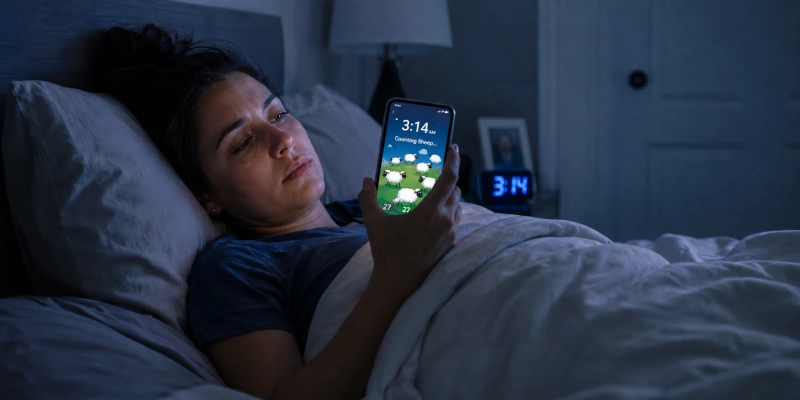
The clock read 3:14 AM. Again. I laid on the edge of my bed, the room glowing with the dull, sickly blue hue of my phone screen. My thumb swiped mindlessly through work emails, a digital nervous tic designed to distract me from the frantic, uneven hum of my own heart.
In the next room, my husband, David, breathed with that infuriating, rhythmic deepness that signaled he was already in his third cycle of REM sleep. It’s called snoring.
I felt like a ghost haunting my own life, a creature of the night, permanently tethered to a body that refused to shut down, even as my soul screamed for the relief of silence.
For years, I had treated sleep like a negotiation. I bargained with it. If I drank less caffeine after 2:00 PM, surely it would come.
If I bought the silk pillowcase, it would visit. If I forced myself into bed by 10:00 PM, it would be an act of submission. But the harder I gripped, the more it slipped away.
My job as a corporate strategy consultant felt like navigating a minefield while wearing a blindfold.
I was snapping at my team, forgetting the names of clients, and convincing myself that “grit” meant functioning on a razor’s edge of exhaustion.
I wasn’t living; I was just surviving until the next crash.
I’m Awake But Dreaming
I was trapped in what I came to call “The Glass Cage of the Morning.” It’s a state some are familiar with, of being aware where you are, awake.
Where you are entirely removed from the biological flow of the day, perpetually watching your life happen from behind a wall of fatigue.
The turning point wasn’t a sleep aid, a tracking app, or a revolutionary pillow. It was a brutal confrontation with the reality of my own biology.
It was the discovery that The Complete Guide to Better Sleep and Circadian Health isn’t about “trying” to sleep.
It is about understanding the hidden, scientific laws that govern the human machine.
The Architecture of Light: Your Eyes Are Not Just for Seeing
For most of my life, I treated the morning as a nuisance. I spent my early hours in my dimly lit home office, drinking coffee in the grey light of dawn.
I shielded myself from the sun until I was “ready” to face the day. I thought I was protecting my sensitive eyes from strain.
Then I met Dr. Aris, a specialist in circadian biology. He looked at me as if I were a car owner trying to fill the gas tank with water. “You’re running in the dark, Elena,” he told me.
The Neuroscience:
My eyes are not merely input devices for images; they are high-precision light sensors.
The retina contains melanopsin-containing ganglion cells, that detect morning light and sends a direct signal to the suprachiasmatic nucleus (SCN), the body’s master clock.
This triggers a necessary cortisol spike to start the day and, crucially, sets a molecular timer for melatonin release approximately 14 to 16 hours later.
By hiding in the dark, I was delaying my biological clock every single morning.
The Philosophical Shift:
I had been living as if I were separate from the natural world, a disembodied brain in a box. I stopped trying to think my way into sleep and started feeling my way into the day.
My identity shifted from “busy professional” to “biological creature,” one whose rhythms were not an inconvenience to be managed, but the foundational architecture of my survival.
I started stepping onto my balcony immediately upon waking, letting the raw, unfiltered morning sky reset my internal clock.
The Temperature Threshold: Why You Can’t Sleep When You’re “Cozy”
I remember the night I stopped wearing socks to bed. It sounds trivial, but it was a violent disruption of my habits.
I had always been “the cold one,” wrapped in layers of fleece, obsessed with staying warm. I thought comfort was the key to rest.
The Neuroscience:
Dr. Aris explained the vasodilation of the extremities. To drop my core body temperature, the biological “go-ahead” for sleep, my body needs to dump heat.
By keeping my feet warm, I was essentially signaling to my brain that it was still the middle of the day.
The Behavioral Layer:
I was fighting my own thermoregulation. When I finally pushed the thermostat down to a chilly 66 degrees and let my feet hang out from under the duvet, the change was visceral.
It wasn’t just physical; it was a surrender. I stopped viewing “being cold” as an attack to be defended against and began viewing it as a physiological state to be invited.
I stopped bracing myself against the world and allowed my body to finally cool down.
The Adenosine Debt: Why Sleeping In Is a Lie
For years, I treated the weekend like a bank account. I would sleep until noon on Saturday and Sunday, thinking I was “balancing the books” on my sleep debt.
Instead, I woke up feeling sluggish, groggy, and “jet-lagged” by Monday.
The Neuroscience:
I didn’t understand the role of adenosine, the chemical byproduct of brain activity that builds up throughout the day and drives our “sleep pressure.”
By sleeping in, I was delaying the buildup of adenosine for the next night, effectively shifting my biological clock to a later zone. I was literally jet-lagging myself every single week.
The Philosophical Shift:
I stopped sleeping in, even when I was exhausted. Waking up at the same time on Sunday as I did on Tuesday was agonizing at first, but the internal result was profound stability.
I stopped viewing sleep as a commodity to be bought and sold, like money in a bank, and started seeing it as a steady, daily heartbeat.
I was no longer a person who “partied” with rest; I was a guardian of my own integrity.
The Cortisol-Melatonin See-Saw: The “Unwinding” Myth
I used to spend my evenings doom-scrolling or watching intense, fast-paced thrillers, convinced it was “unwinding.”
My brain was flooded with cortisol, which acts as a molecular antagonist to melatonin. I was effectively drinking stimulants while lying in bed.
The Neuroscience:
One evening, I turned off the television two hours before bed, replaced the light bulbs in my hallway with low-intensity, warm-spectrum lamps, and sat in silence with a paper book.
My brain needed the cortisol to wane naturally, not to be suppressed by blue light and high-stakes visual stimulation.
The Behavioral Layer:
The silence was deafening at first, revealing how addicted I was to external stimulation. I had been using dopamine hits to mask the fact that I didn’t know how to be alone with my own thoughts.
By allowing that cortisol to naturally dissipate, I finally felt the tide of sleepiness arrive, not as a crash, but as a gentle, heavy wave.
I realized that my need for constant “entertainment” was just a fear of my own interiority. I wasn’t just changing my sleep; I was learning to like the person I became in the quiet.
Social Jetlag: Your Rhythm is Your Boundary
My job required late-night networking dinners, which were the final nail in the coffin of my circadian rhythm. I felt I had to choose between my career and my health.
The Neuroscience:
Circadian health is a social act. When your internal clock disagrees with your environment, you are in a constant state of biological dissonance, which ripples out into cognitive function, mood stability, and immune health.
The Philosophical Shift:
I had to make the hardest decision of my career: I stopped attending them. When my boss asked why, I didn’t give an excuse about “needing sleep.”
I told the truth: “I am biologically incapable of being high-functioning past 9:00 PM.” It felt like a betrayal of my ambition.
But the biological reality was that I was sacrificing my long-term cognitive health for short-term social capital. Once I drew that boundary, my body finally exhaled.
My hormones normalized. My anxiety, which had been masquerading as “stress”, evaporated, because it was really just the physiological manifestation of a body fighting its own chemistry.
Reflections: How to Reset Your Own Rhythm
The transformation felt earned because it required a total recalibration of my daily life. I stopped trying to outsmart the biological machine I inhabit.
If you are struggling with your own “Glass Cage,” here are five reflections to help you shift your perspective and your habits:
- Seek the Sun: Your internal clock needs a anchor. Get outside within 30 minutes of waking. Natural light is the most powerful reset button your biology possesses.
- Cool the Core: Create a sleep environment that invites the body to shed heat. If your room is too warm, your biology will reject sleep. Lower the thermostat and prioritize breathability.
- Honor the Rhythm: Stop trying to “make up” for lost time. A consistent wake-up time is more valuable to your brain than an extra three hours of sleep on a Sunday morning.
- Protect the Twilight: Your evening wind-down should be a “dopamine-fast.” Remove the screens. Lower the lights. Give your brain the chemical space to produce the melatonin it needs for deep, restorative rest.
- Define Your Boundaries: Recognize that your circadian rhythm is a legitimate physical need. If your social or professional life requires you to consistently work against your biology, you are not just “working hard,” you are eroding the foundation of your health.
Found Sound Sleep
Six months later, the 3:00 AM panic is a memory from a different life. I wake up, not to an alarm, but to the slow, golden creep of light across my floor. My body feels heavy in a good way, anchored, real, and present.
We spend our lives trying to conquer the day, never realizing that the battle is actually won, or lost, in the quiet, dark hours we’ve spent our whole lives trying to escape.