


You’ve held a deck of cards a hundred times. Felt the slight flex, heard that soft riffling sound of shuffling, maybe even fanned them without thinking. And the whole time without you realizing, a complete year was sitting in your hands. A standard deck of 52 playing cards isn’t just for solitaire.
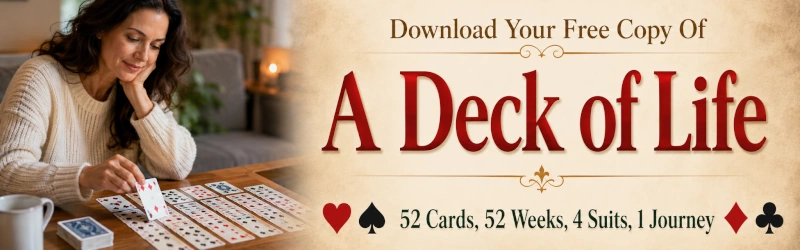
It’s a pocket calendar. Four suits for the seasons. Thirteen cards in each suit for the weeks that make up those seasons. Twelve face cards for the months. Two colors for day and night.
Add the values the right way and you even get the 365 days. Once you see it, you can’t unsee it. Every shuffle starts to feel a little different.
This wasn’t some clever modern invention. The pattern settled into place over centuries as cards moved from China through the Islamic world into Europe, and finally locked into the French suits we all recognize.
What follows is the full picture—the clean math, the real history, the overlapping symbols, and the quiet ways you can actually use the deck as a living calendar.
The Math You Can Check in Thirty Seconds
Take a deck. Set the jokers aside for now. Fifty-two cards.
• Fifty-two cards for the fifty-two weeks
• Four suits for the four seasons
Traditional Calendar Symbolism
• Spades: Often matched with Winter
• Diamonds: Often matched with Spring
• Hearts: Often matched with Summer
• Clubs: Often matched with Autumn (or Fall)
• Thirteen ranks in every suit for the thirteen weeks that sit inside each season
• Twelve court cards—the jacks, queens, and kings—for the twelve months
• Red and black for day and night
If you give Ace the value of 1 and run straight through to King as 13, the whole deck adds up to 364.
One joker brings it to 365. The second joker has long been treated as the leap-day or the little drift of time that doesn’t fit neatly. The numbers line up with almost embarrassing neatness.
That simple set of equivalences is why people keep rediscovering the idea.
It satisfies the straightforward questions—why 52 cards, why four suits, why thirteen ranks—while opening a deeper sense of recognition. The deck stops feeling arbitrary.
Four Suits, Four Seasons
Hearts, diamonds, clubs, spades. In the calendar reading they become the hinges of the year.
The seasons themselves, and by extension the solstices and equinoxes that turn them.
Different traditions argue over which suit belongs to which season, but the four-part division never changes.
Thirteen Cards, Thirteen Weeks
Thirteen has always been the restless number. There are roughly thirteen lunar cycles in a solar year, and exactly thirteen weeks if you divide the year into four even seasons.
Each suit becomes a complete seasonal arc—from the Ace as beginning, through the numbered days, to the court cards as culmination.
The Courts, the Colors, and the Jokers
The twelve face cards form their own quieter wheel of the months. Red and black keep the daily pulse of light and dark.
The jokers, latecomers originally made for euchre, slip in as the extra days, the leap-year variables, the parts of time that refuse to stay in clean boxes.
The Clock in the Cards
Have you ever wondered why the exact same task feels like a crushing burden on a Tuesday in November, but a brisk, manageable sprint on a Wednesday in May?
Most people blame their mood. They blame their stress levels. They blame the economy, or the weather, or a vague sense of burnout.
But the answer isn’t hiding in your schedule or your bank account. It is hiding in plain sight, tucked away in an object most of us haven’t seriously looked at in years: a standard deck of playing cards.
There is a strange, quiet architecture to human existence. We like to think we are masters of our own time, autonomous agents moving through a linear calendar. We are not.
We are biological clocks masquerading as free-willed people. And the deck of cards? It wasn’t just designed for gambling. It was designed to keep us sane.
The Fifty-Two Week Mirror
Look at a deck of cards. Fifty-two cards. Four suits. Thirteen cards per suit. It is easy to dismiss this as mere coincidence. It is easy to say it’s just how the math works out.
But our ancestors were not interested in “coincidence.” They were interested in survival. They built the deck as a mnemonic device, a tactile representation of the solar year.
Fifty-two cards. Fifty-two weeks. The deck is a physical artifact of the way the Earth spins around the sun.
When you hold a deck of cards, you are holding the rhythm of the seasons in the palm of your hand. This isn’t just about counting weeks; it’s about entrainment.
It’s about the way the human brain, specifically the prefrontal cortex, struggles to make sense of time without a tether.
The Brain Needs a Map
The prefrontal cortex is the executive center of your brain. It is the part of you that plans, executes, and worries.
It is where you hold your vision for the future. But the prefrontal cortex has a fatal flaw: it is biologically blind to the passage of time.
You can feel emotions. You can feel physical pain. But you cannot “feel” a Tuesday. You cannot “see” a fiscal quarter. These are social constructs. They are invisible threads holding our society together.
When we lose our connection to the natural cycle of the year, our prefrontal cortex goes into overdrive, trying to create structure out of a void.
It starts firing rapidly, trying to anchor itself in a world that feels increasingly unmoored. This is why people feel that distinct, low-level hum of anxiety when they are disconnected from the seasons.
Imagine a pilot trying to land a plane without an altimeter. They are constantly checking their instruments, constantly worried about how high or low they are, because they lack the objective data.
That is your brain when it loses its seasonal tether. It panics. It works harder. It burns fuel it doesn’t need to burn.
The Seasonal Shift
The deck of cards acts as a “cognitive scaffold.” By playing with these symbols, we were, for centuries, essentially “re-calibrating” our internal clocks.
Think about the biological reality of the seasons. In the spring, your brain is wired for expansion, for growth, for what we call the “new.”
Neurochemically, this is a surge. In the autumn, the brain shifts into a consolidation phase. It is about storage. It is about preparing for the scarcity of winter.
If you are trying to force a “spring” mindset, a mindset of pure, aggressive growth, in the middle of your own internal “winter,” you are going to break. You are going to burn out.
We do this constantly. We treat our productivity as if it should be a flat line. We expect the same output in the dark, cold days of late autumn as we do in the long, light-filled days of mid-summer.
But our biology is not a flat line. It is a wave. And that wave is dictated by the seasons.
The Geometry of Order
This is why ancient systems, the ones that gave us the deck of cards, were so powerful. They didn’t view the year as a flat line. They viewed it as a circle.
They understood that the thirteen cards of a suit represent the thirteen lunar months. They understood that you move through phases.
You have the “Ace” phase, the beginning. You have the “King” phase, the culmination. And then, crucially, you have the reset.
When you lose the ability to see the cycle, you lose the ability to pace yourself. You sprint at the beginning of the race, and you sprint at the end of the race, and you wonder why you collapse in the middle.
By acknowledging the seasonal nature of your own psychology, you regain your pacing. You stop trying to build a business or learn a language or fix a relationship with the same intensity every single day.
You recognize in the “winter” of your life, when external conditions are tough or internal energy is low, the right move isn’t to push harder.
It is to consolidate. It is to protect your resources. It is to prepare for the inevitable return of spring.
The Last Card
There is a final, rarely discussed truth about this system. When you look at the deck, you see the structure. You see the order. But you also see the game.
The game is what happens when you bring another person into your orbit. When you play, you are aligning your cycle with someone else’s.
That is the true function of the deck: to harmonize human behavior. To give us a shared language for the passage of time.
If you are feeling unmoored today, if you are feeling that persistent, low-grade stress that seems to have no origin, look at the calendar.
Look at the season. Understand that you are not a machine. You are a biological entity moving through a cosmic cycle.
1 thought on “Why A Deck Of 52 Cards Is The Key To Predicting Your Future”