

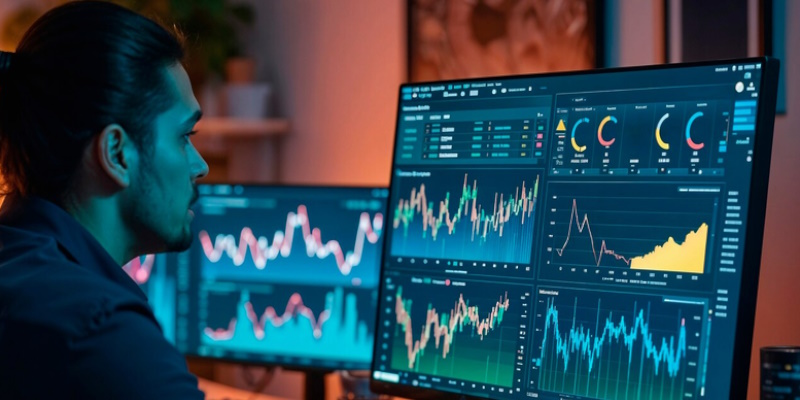
For the first six months, I thought I was living the dream. I was a digital nomad in my own spare bedroom. I had a triple-monitor setup, a Herman Miller chair that cost more than my first car, and a subscription to every live news feed that mattered. I was daytrading the Forex market.
My commute was twelve seconds long, just the time it took to shuffle from the kitchen coffee pot to the desk. The dream lifestyle… right?
I remember standing in my living room one Tuesday morning, the sun streaming in, feeling a swell of pride. I had just banked three hundred dollars on a XAU/USD scalp. I was the trader. I was free.
But I wasn’t free. I was a hostage in my own home. My wife stopped coming into my office to chat because she knew the mood was always tied to the charts.
If I was green, I was manic and distracted. If I was red, I was a ghost, physically present, but mentally locked in a spiral of what ifs.
I had fallen into a trap almost every home-based day trader encounters, yet rarely talks about. I was struggling with the Illusion of Environmental Mastery.
I believed that by bringing the battlefield into my sanctuary, I was optimizing my life. In reality, I was systematically destroying my nervous system’s ability to recover.
The Architecture of the Modern Trap
When we think of high-stakes environments, we picture Wall Street floors, noisy, chaotic, but physically separated from the bedroom or the kitchen table.
In those spaces, you leave work when you walk out the glass doors. Your brain receives a definitive sensory signal: The threat is over. It is time to recover.
At home, that boundary is obliterated. My cockpit was five feet from where I slept. My battlefield was ten feet from where I ate dinner.
This isn’t just a matter of work-life balance. It is a fundamental neurological issue. Our brains rely on a process called context-dependent cognition.
The Lack of Separation
We are evolved to associate specific environments with specific survival behaviors. When you sit at a desk in a professional office, your brain enters work mode.
When you are in your living room, your brain is signaled to enter rest and digest mode.
By forcing my brain to perform high-stakes financial speculation, a task that activates the sympathetic nervous system, triggers the amygdala.
Doing so floods the body with adrenaline and cortisol. This in the same room where I was supposed to be vulnerable, intimate, and restful, I was creating a neurological dissonance.
I wasn’t just trading Forex; I was training my brain to associate my home with perpetual, low-grade stress.
The Science of the Sanctuary Collapse
This is your body’s stress response system. When you execute a trade with real capital on the line, you are effectively triggering a fight-or-flight response.
You are biologically reacting as if you are being hunted by a predator, even if you are just staring at a flickering candle chart.
In a normal work environment, after a stressful event, you have a transition period. You commute, you talk to coworkers, you change your scenery. Your HPA axis returns to baseline.
But at home? There is no transition. The trade ends, and you stand up to go make a sandwich. Your body is still flooded with adrenaline.
But your amygdala, the part of the brain responsible for processing fear and threat, is still hyper-vigilant, scanning the horizon for the next market dip.
Over months, this constant state of activation leads to allostatic load. This is the wear and tear on the body and brain that accumulates when an individual is exposed to repeated or chronic stress.
My sleep quality plummeted. My resting heart rate rose. I started experiencing anticipatory anxiety, a dread that manifested every time I walked into that room, even before the market opened.
I wasn’t just a bad trader. I was a biologically exhausted human being.
The Identity Crisis: When the Cockpit Becomes the Cage
The hardest part to admit was the philosophical shift. I defined myself by my autonomy. I told myself that the freedom to trade at home was the ultimate success.
To admit that this lifestyle was poisoning my quality of life felt like admitting I had failed at the very life I had built.
I held onto the desk. I kept the screens. I justified it by saying, I just need a better system, or I just need to control my emotions better. But the truth was deeper.
I had lost the ability to distinguish between work and life because I had removed the physical constraints that help the brain categorize them.
Philosophically, I had become a human extension of the trading terminal.
When the market moved, I moved. My identity shifted from being a husband, a friend, and a person with hobbies, to being a node in a global financial network.
The house, meant to be a place of recovery, had become a permanent, high-arousal zone. I was no longer resting; I was simply un-deployed. And that is no way to live.
The Turning Point: Why Boundaries Save Your Career (and Your Life)
The change didn’t happen because I found a better trading strategy. It happened because I finally realized that environmental mastery is a myth.
You cannot master an environment that you have colonized with your own stress. I took a radical step. I moved the office out of the house.
I rented a small, boring, unadorned cubicle in a co-working space three miles away. The first week was agonizing.
I felt a phantom need to check the charts at 9:00 PM. But as the weeks passed, a profound shift occurred in my physiology. When I came home, my brain knew that the cockpit was miles away.
The cortisol levels in my system finally had a chance to drop. I started sleeping through the night for the first time in years.
My trading didn’t get easier, but my performance stabilized. Because I was no longer carrying the stress of the market into my bed, my decision-making became clearer.
I was no longer trading to soothe my anxiety; I was trading with a calm, analytical mind.